Deadly Landslides Return Every Monsoon in Bangladesh
By Turjo Rahman
With the arrival of the monsoon season, fear grows once again in Bangladesh’s hilly regions. Every year, continuous rainfall triggers deadly landslides that claim lives and destroy homes. The districts most at risk include Chattogram, Rangamati, Bandarban, Khagrachhari, Cox’s Bazar, and Sylhet.
Experts say that while heavy rainfall is the primary natural cause, human activities such as deforestation, illegal hill cutting, and unplanned settlements have made the disaster far more severe. They believe that effective planning and stricter enforcement could significantly reduce annual casualties.
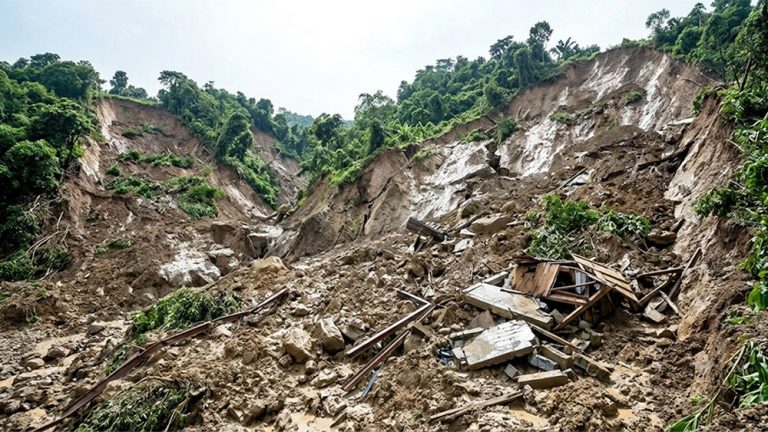
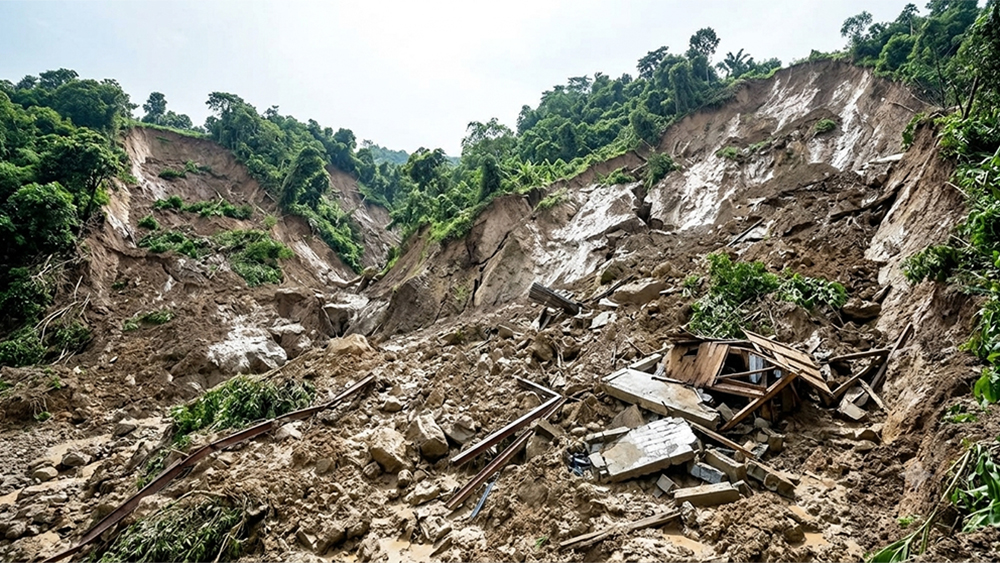
Landslides have become a recurring disaster rather than isolated incidents. Almost every monsoon season, heavy rains cause slopes to collapse somewhere in the country. This year, four members of the same family were killed in Sylhet after a rain-induced landslide buried their home. During the same period, authorities opened hundreds of emergency shelters in Rangamati, Bandarban, and Khagrachhari and evacuated thousands of residents from high-risk areas.
Most recently, in July 2026, at least eight people, including women and children, were killed in a devastating landslide at the Rohingya refugee camps in Cox’s Bazar. Continuous rainfall caused hillsides to collapse, burying several shelters under mud and debris. Thousands of other refugees were later relocated to safer locations.
Research indicates that between 2000 and 2018, Bangladesh experienced at least 204 major landslides, resulting in 727 deaths and more than 1,000 injuries. Nearly 83 percent of these incidents were triggered by heavy rainfall, with an average of 19 landslides occurring each year. From 2019 to 2025, landslides continued to strike the hill districts almost every monsoon, causing further casualties and affecting thousands of families. Experts warn that the overall risk has shown little sign of declining.
One of the deadliest landslide disasters in the country’s history occurred on June 13, 2017, when massive landslides in Rangamati, Chattogram, and Bandarban killed at least 125 people and injured hundreds more. Roads, homes, and power infrastructure suffered extensive damage. Despite the tragedy, landslides continue to occur almost every year.
According to experts, excessive rainfall alone is not responsible for these disasters. Illegal hill cutting, widespread deforestation, construction of settlements on unstable slopes, and poorly planned development projects have greatly increased the risk. The removal of trees weakens the soil, making hillsides far more vulnerable to collapse during heavy rain.
The Rohingya refugee camps in Cox’s Bazar remain among the country’s most vulnerable locations. More than 1.2 million Rohingya refugees live in shelters made of bamboo and tarpaulin on steep hillsides. During the monsoon season, these camps face constant threats from landslides and flash floods. In just two days in June 2025, authorities recorded 53 landslides across 33 refugee camps, damaging more than 1,400 shelters.
Experts point to countries such as Japan, Switzerland, and Norway as examples of effective landslide risk management. These countries strictly regulate construction on unstable slopes, issue early warnings before heavy rainfall, evacuate residents from danger zones when necessary, and continuously monitor hillside conditions. Any signs of ground movement or cracks are addressed immediately.
Specialists recommend similar measures for Bangladesh. They emphasize the need to regularly update maps of high-risk hillsides, prohibit new settlements in vulnerable areas, completely stop illegal hill cutting, and expand tree plantation programs to strengthen soil stability.
They also stress the importance of introducing modern landslide early warning systems. By analyzing weather conditions, rainfall patterns, and soil moisture data, authorities can identify potential risks in advance and provide timely warnings, allowing residents to evacuate before disaster strikes.
Improved drainage systems are equally important in hilly areas. Water trapped in the soil increases pressure on slopes and raises the likelihood of collapse. Engineering standards should also be strictly followed when constructing roads and infrastructure in mountainous regions.
Experts further highlight the importance of public awareness. During the monsoon season, residents should avoid living on unstable hillsides, follow evacuation orders issued by local authorities, and help prevent illegal hill cutting within their communities.
According to disaster management specialists, while landslides cannot be completely prevented, the number of deaths can be significantly reduced through stronger law enforcement, environmental conservation, modern technology, and timely government action. With proper planning and sustained efforts, Bangladesh can greatly reduce the human toll of landslides during future monsoon seasons.
About the Author